Kittenbaby.com FREE Wallpapers!
Kittenbaby.com Wallpapers etc.
|

251 images in 23 categories.
| |||||||||
|
Learn about bottle feeding a kitten, choosing the right kitten formula and milkreplacer, kitten care and kitten health, litter box training and kitten behavior, kitten health care and kitten diseases with all the symptoms and treatments, along with many kitten photos and pictures.
|
| |||||||||
|
Newborn kittens and puppies receive complete nutrition from their mothers’ milk for the first four weeks of life. As they gradually begin to eat on their own, they will be fully weaned after a few more weeks. During the first weeks of life, body weight may double or triple, and this rapid growth will continue—although at a gradually decreasing rate—until maturity. Large amounts of energy and nutrients are required in balanced quantities to support this spectacular growth.
Here are our top ten tips for feeding puppies and kittens:
1. Kittens are best fed mom's milk; it's 100-percent perfect for their needs. However, if the mother is ill or doesn’t produce enough milk, or if the kittens are found as orphans, it is necessary to feed them a commercial milk replacer.
2. Generally, orphaned or hand-fed kittens can be offered moistened kitten food at about three weeks of age. Use a commercial milk replacer to moisten the food, and gradually reduce the amount of milk replacer you use, until the kittens are eating dry kitten food at about five or six weeks of age.
3. At first, curious kittens will probably want to play with their food rather than eat it, but the youngsters will soon catch on as they watch mom eat. By the time kittens are five to six weeks old, they should be nibbling on dry food consistently. This process of gradually introducing kitten food is important in training the cats to eat when they are weaned.
4. After weaning, kittens can be fed free-choice—dry or nutrient-dense kitten-formula canned food. Make sure fresh water is available at all times.
5. Most queens will suckle their kittens until about eight weeks of age. By this time, 80- to 90-percent of the kitten's total nutrient intake should be from kitten food. Kittens need large amounts of energy—about two to three times that of an adult cat. Kittens also need about 30 percent of their total energy from protein. Make sure the food you offer is specifically formulated for kittens; your pet will need to eat kitten-formula food until she reaches maturity, at about one year.
6. Canines generally begin eating puppy food at about three or four weeks, and are completely weaned by seven or eight weeks. They require up to twice the energy intake of adults and, depending on the breed, will need to have 25- to 30-percent protein.
7. As with kittens, puppies should have puppy food available prior to weaning. These meals should begin when the pups are three to four weeks old; start with small quantities. Puppies often play in their food when it is first introduced, but they will quickly learn what to do with it! By the time the pups are ready to wean at six to eight weeks old, they should be eating their dry food consistently.
8. Small breeds of dogs reach mature body weight in nine to twelve months, while giant breeds may not be mature until they reach their second birthday.
9. Just who are we calling SMALL? Small-breed dogs are 20 pounds or less. As pups, they can often be fed free-choice. When food is readily available, most small-breed dogs will develop good eating habits and not become overweight. If you have other pets, you should probably feed your small-breed dog by the portion control method.
10. Most medium-breed puppies (adult size between 20 and 50 pounds) and all large or giant breed pups (more than 50 pounds as adults) are best fed with the portion control method.
BONUS! Special Concerns about Feeding Large- and Giant-Breed Puppies
If puppies are allowed to overeat, they may consume too many calories and too much calcium, grow too rapidly and develop bone growth problems. In breeds that are prone to these diseases, such as many large and giant breeds, overfeeding can lead to an increased frequency of hypertrophic osteodystrophy (HOD), osteochondrosis (OCD) and hip dysplasia.
Clinical signs often seen with bone growth disease include bowing of the front legs. Sometimes, these signs are misdiagnosed as calcium deficiency (also known as rickets). Radiographs are crucial for an accurate diagnosis. Adding more calcium to the diets of dogs with HOD, OCD or hip dysplasia will actually worsen the condition—and may result in permanent damage.
It is important to aim for a slower rate of growth with large and giant breed puppies. Do not overfeed, or try to push the growth rate too fast. Controlled feeding of a balanced diet specifically made for large- and giant-breed puppies facilitates optimal skeletal development. Remember, the adult size of a dog is determined genetically—not by how fast the animal grows.
|
|
|
|
| |||||
|
|
|
LOOKING FOR A SWEET EASTER TREAT? THE BEST BUNNIES ARE CHOCOLATE ONES!
It's that time of year again, and real live bunnies will be on their way into many homes in America this April 16—courtesy of well-meaning parents who think they're buying a low-maintenance starter pet for the kids. Unfortunately, young children and bunnies aren't at all a good match—and when the novelty wears off, many of these Easter rabbits will wind up at shelters. Unlucky ones may be dumped outside where they must face predators, cars, illness and injury. Still others are destined to lives of neglect and boredom in cramped cages.
If your family's set on getting a rabbit, give a chocolate bunny or a stuffed toy for Easter and, if your young children are really serious, a book on rabbit care. If they're still begging you for a bun after the holiday has passed, go to your local shelter or rescue group and find out how to adopt the rabbit (or even better, a bonded pair) of your dreams. For info on bunny care and rescue groups, head to the House Rabbit Society online.
You can also help spread the word that rabbits are not disposable pets by getting involved in the "Make Mine Chocolate!" campaign. Started in 2002 by the Columbus House Rabbit Society, the Make Mine Chocolate! campaign aims to educate the public about the challenges of properly caring for rabbits and encourages parents to give chocolate or toy bunnies as Easter gifts instead of live rabbits. Check out the group's website, MakeMineChocolate.org, where you can visit the interactive learning center, buy a Make Mine Chocolate! tee or pin, and test your knowledge of bunny nutrition with the "What Will You Feed Your Rabbit?" game.I am happy to announce that the Wildlife and Pet Forum on the Rainbow Wildlife Rescue site is
finally launched!
3 days ago I was called by a lady who was given my number from the local animal shelter. She said her cat was attacked by a dog and she had 2 kittens that just opened their eyes, but weren't doing so good. She had tried to feed them with an eyedropper with what I assume was cow's milk.
Of course I accepted the 2 kittens, a male and a female. The male fell into a coma the next day, but came around again. He had pneumonia from the cow's milk ending up in his respitory system. He had terrible diarrhea and no control about his bodily functions.
After he screamed in pain for a while, I decided it's best to relief him of his suffering.
On the way to the vet, he fell into a coma again and never woke up.
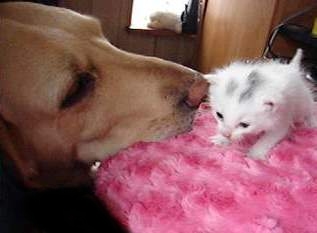
His sister Sally is doing great though! With the Lab Butters to help a bit: